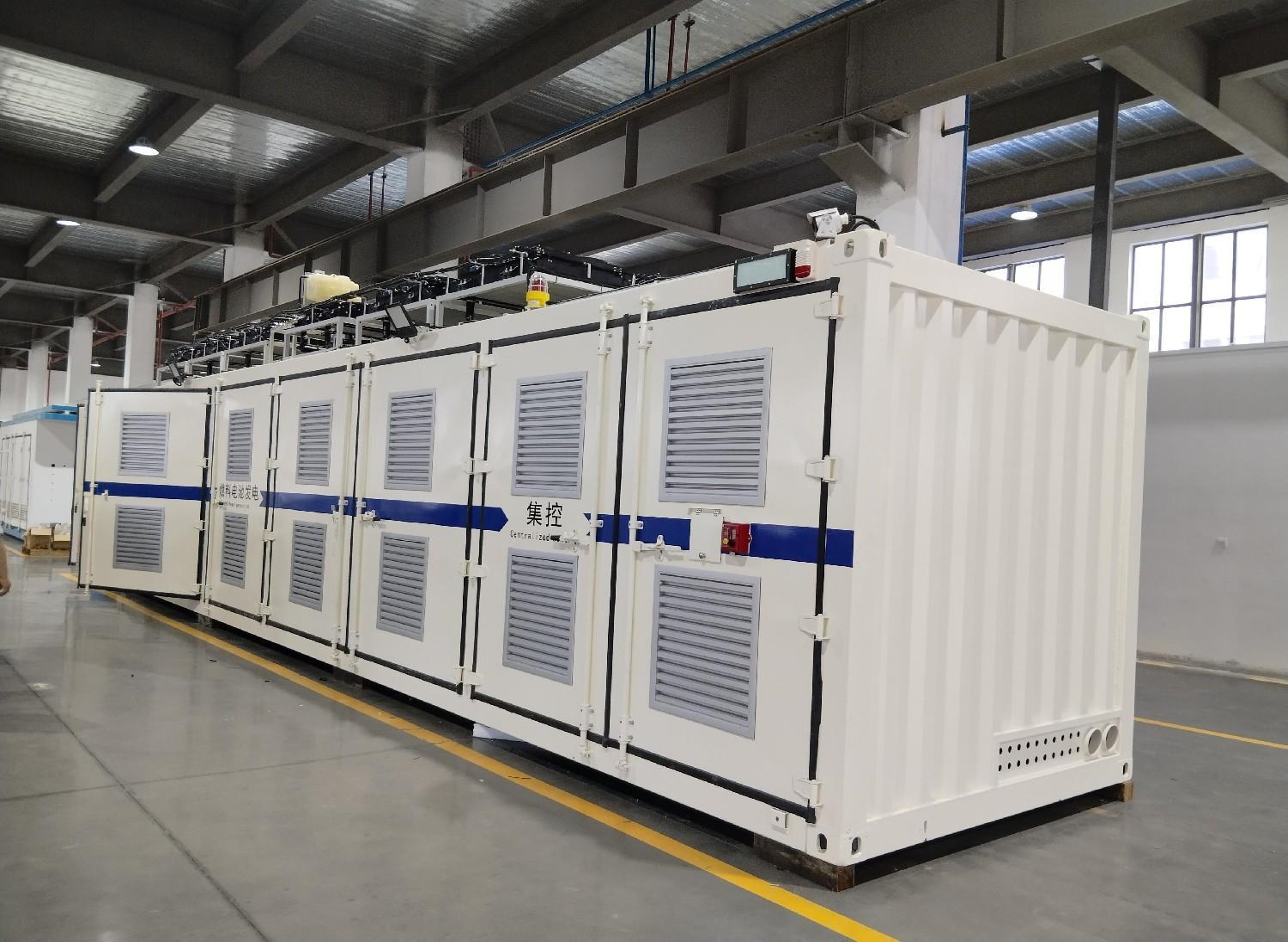
The natural gas situation.
Most North American data center markets already sit on dense, well-maintained natural gas pipeline networks. Hydrogen pipelines — while expanding — are still concentrated along industrial corridors in Texas, Louisiana, and parts of California. For the majority of sites, hydrogen delivery means trucking, rail, or waiting on infrastructure that doesn't exist yet.
An integrated SMR + PEM fuel cell system flips the problem. Instead of importing hydrogen, you make it on site — from the natural gas you already have — and convert it into clean electricity through Horizon's PEM fuel cells.
If you can get natural gas to your site, you can get hydrogen to your fuel cells. On-site SMR removes the hydrogen supply chain as a deployment blocker — without giving up the operational benefits of fuel cell power.
How the integrated system works.
The architecture is straightforward and field-proven across decades of industrial hydrogen production:
- Pipeline natural gas enters the on-site SMR unit after desulfurization to protect downstream catalysts.
- Steam Methane Reforming reacts methane (CH4) with steam at 800–900°C over a nickel catalyst, producing a syngas mixture of hydrogen and carbon monoxide.
- Water-Gas Shift converts the carbon monoxide into additional hydrogen and CO2, boosting yield.
- Pressure Swing Adsorption (PSA) purifies the hydrogen to fuel-cell-grade 99.999% purity.
- Horizon PEM fuel cells convert that hydrogen into electricity at up to 54% rated power efficiency, with water vapor as the only direct byproduct.
- Optional carbon capture takes the concentrated CO2 stream from PSA and either compresses it for sale or sequesters it — qualifying for 45Q tax credits.
System specifications.
The figures below represent a typical Horizon-scale deployment. Actual configurations are tuned to site load, fuel composition, and emissions requirements.
- Module power
- 3 MW per Horizon PEM container; modular to 10 MW+ blocks and 100 MW+ sites
- Hydrogen purity
- 99.999% from integrated PSA — fuel-cell-grade
- Reformer temperature
- 800–900°C with 2.5:1 to 3:1 steam-to-carbon ratio
- System efficiency
- Up to 75–80% total efficiency with CHP heat recovery (electrical efficiency at the cell up to 54%)
- Carbon capture
- Up to 95% CO2 capture rate from concentrated PSA off-gas stream
- Deployment timeline
- As low as 4 months for the fuel cell side; SMR adds modest civil work and permitting time
- Footprint
- Containerized fuel cell modules; SMR skid sized to site H2 demand
Why pair on-site SMR with PEM — not a turbine?
Industrial sites have used gas turbines for distributed power for decades. So why route the same natural gas through SMR and a fuel cell instead?
Carbon math and tax credits.
Conventional grey-hydrogen SMR emits roughly 8.7–9.2 kg of CO2 per kg of H2 produced. With a 95% capture-rate carbon-capture system bolted on, that drops to about 0.4–0.5 kg CO2/kg H2 — qualifying for federal Section 45Q credits on captured CO2 and putting on-site emissions firmly in "blue hydrogen" territory.
From the fuel cell down, the system emits only water. CO2 from the reforming process is a concentrated, single point source — far easier to capture than diluted turbine exhaust, where capture costs balloon with the flue gas volume.
A bridge, not a destination.
The defining feature of the integrated approach is fuel flexibility. The same PEM fuel cell plant runs on grey, blue, or green hydrogen interchangeably. Today, you produce hydrogen from natural gas on site. As hydrogen pipelines reach your geography, or as your campus adds renewable electrolysis, you change the H2 source — not the power plant. The fuel cells, balance-of-plant, electrical interconnect, and SCADA stay exactly the same.
A natural gas turbine, by contrast, is permanently a combustion asset. The path to clean power requires retiring it, not evolving it.
If your site has natural gas and you need clean, reliable, four-9s power yesterday — integrated SMR + PEM is the fastest way there. And it's the only path that doesn't strand your investment when hydrogen markets mature.
Sizing & engagement.
Horizon's typical engagement runs along these stages:
- Site assessment. Load profile, gas-supply capacity, water availability, footprint, redundancy targets, emissions constraints.
- System sizing. H2 production capacity, number of PEM modules, storage buffer, optional CCS sizing.
- Permitting and interconnection. We handle CARB / EPA / local AHJ engagement; SMR adds standard industrial-gas permitting.
- Manufacturing. Containerized PEM modules ship from Horizon's Foshan factory; SMR skid sourced from partners with field-proven small-scale designs.
- Commissioning. Civil work, electrical, grid sync, load testing, handover.
- Operations. 24/7 remote monitoring, scheduled maintenance, performance guarantees.
Have a site in mind?
Tell us about your load, your gas supply, and your deployment window. We'll run a free, no-obligation sizing pass and share what an integrated SMR + PEM system would look like for your facility.